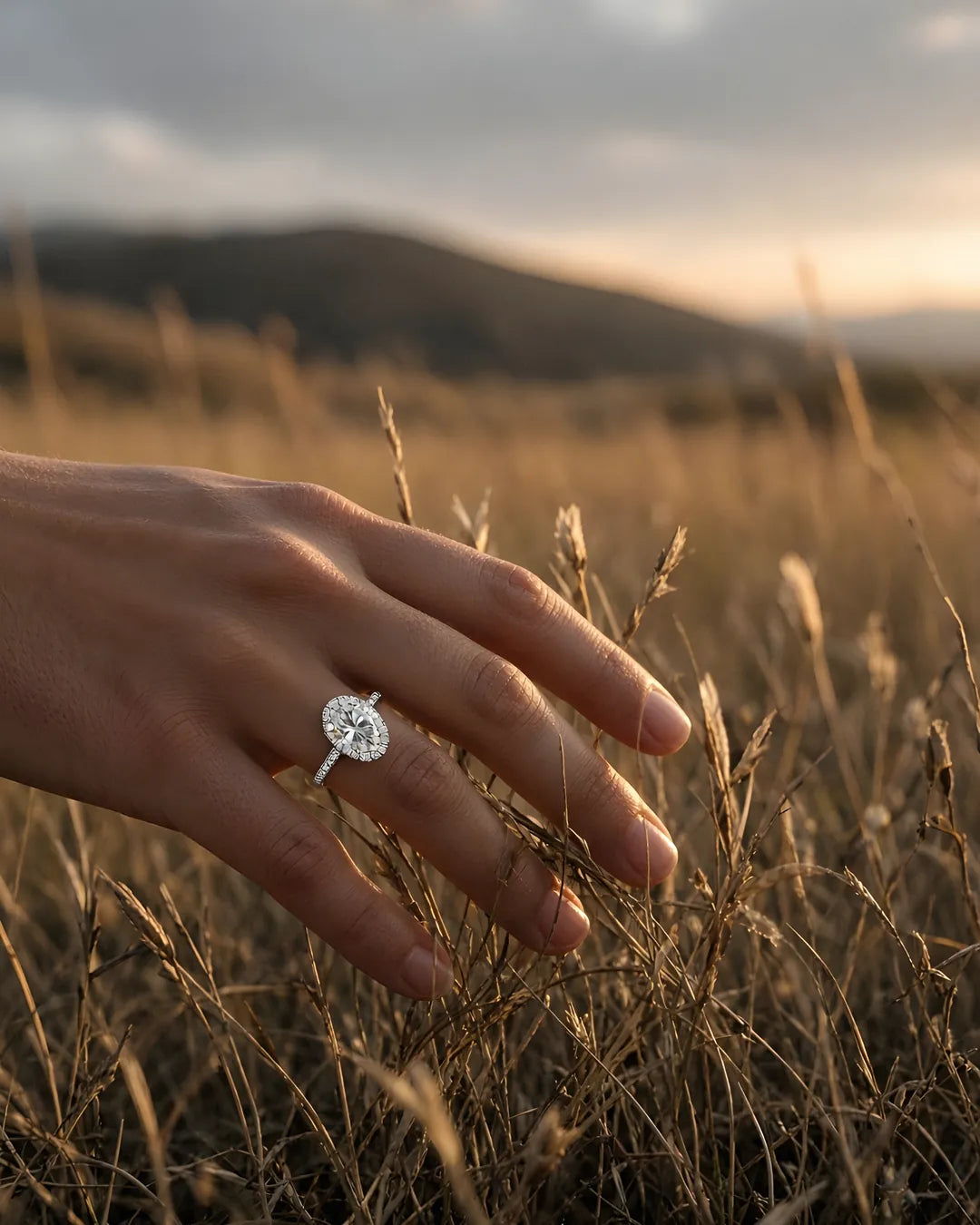
Why ovals are so popular
The oval combines the sparkle of a round brilliant with an elongated outline. It is a modified brilliant cut, so it returns plenty of light, while its length flatters the finger and makes the stone face up larger than a round of the same weight. It is versatile too: it can feel classic in a solitaire, glamorous in a halo or quietly modern in a bezel.

Length-to-width ratio
The ratio is the stone's length divided by its width, and it is the single biggest factor in how an oval looks.
- Around 1.30–1.40: a balanced, classic oval.
- Around 1.40–1.50: slimmer and more elongated.
- Above 1.50: long and dramatic, almost a marquise-like line without the points.
- Below 1.30: rounder and softer.
There is no "best" ratio. Look at examples on a hand and notice what you prefer. Long fingers can carry a slimmer oval. Shorter fingers often look elongated by any oval.
The bow-tie effect
Most ovals show a darker area across the centre, shaped like a bow tie. It comes from the way light leaks through the stone at certain angles. Nearly every oval has some bow-tie. The question is how strong it is.
- A subtle, soft bow-tie adds contrast and character.
- A dark, heavy bow-tie looks like a shadow across the stone.
The bow-tie is not shown on a grading report, so judge it from images or video of the actual stone in face-up view. This is one reason we review the individual stone with you rather than choosing from numbers alone.
Face-up size
Ovals spread their weight across a larger top surface than many shapes, so they face up generously for their carat weight. When comparing stones, look at the millimetre length and width as well as carat. Our carat vs millimetres guide explains why two 1.5 ct ovals can look different sizes, and our carat on the hand guide helps you picture it on your finger size.
Colour and clarity
As a brilliant-style cut, an oval hides small inclusions reasonably well, so an eye-clean stone does not require the very highest clarity grade. Colour can concentrate slightly at the ends of an elongated shape, so in white gold some people prefer a higher colour grade. Yellow and rose gold give more flexibility.
Settings for an oval
Solitaire
Four or six claws hold the stone. Four claws show more of the diamond. Six claws add security and a softer outline. This is the cleanest way to show the oval's shape.
Hidden halo
A row of small diamonds beneath the centre stone adds sparkle from the side while keeping the top view pure. It is one of the most requested details for ovals.
Halo
A frame of small diamonds around the oval increases face-up presence and sparkle. A halo can also make a lightly warm stone look whiter by surrounding it with bright accents.
Pavé band
Small diamonds along the band add continuous light. Pavé pairs well with all of the above. Keep the band slim to let the centre stone lead.
East-west
Setting the oval horizontally across the finger gives a modern, unexpected look. It sits lower and suits people who want something less traditional.
Explore these outlines in our Setting Gallery.
Metal
- 18k white gold feels bright and contemporary.
- 18k yellow gold is warm and classic, and it contrasts beautifully with a white oval.
- 18k rose gold is soft and romantic.
If you cannot choose, a two-tone design is possible. For example, a white gold head for the stone can sit on a yellow gold band.
Protecting the tips
An oval has no sharp points, but its ends are its narrowest parts. Claws placed at the ends, or a halo or bezel, protect them during daily wear.
Oval vs other shapes
- Oval vs round: the oval faces up larger and elongates the finger, while the round has maximum sparkle and symmetry.
- Oval vs emerald: the oval has brilliant sparkle, while the emerald has calm, mirror-like flashes. See our emerald vs oval comparison.
How we design an oval ring
We help you choose the individual stone, including how strong its bow-tie is. Then a hand-drawn line sketch sets the outline. A CAD model built to the exact measurements of your oval follows, and nothing is made until you approve it.
A 75% deposit begins the commission, and the balance is due after CAD approval. The deposit is refundable if you cancel before production. Because every ring is made for one person, we do not accept returns after production. One size change is free (you cover shipping). A change of up to 2 Hong Kong sizes is possible but requires a new band, charged separately; your centre diamond is reused. See the Custom Order Terms.

Oval proportions beyond the ratio
Two ovals with the same ratio can still look different. Ask about:
- Depth percentage. A stone that is too deep carries weight below the girdle and looks smaller from above.
- Shoulders. Ovals can have fuller or narrower "shoulders" near the ends. Fuller shoulders look softer and rounder, and narrower ones look sleeker.
- Symmetry. The two halves should mirror each other. Slight asymmetry is often visible in an elongated shape.
These details are best judged from images of the actual stone. We review them with you before you choose.
Pairing a wedding band
A low-set oval solitaire often lets a straight band sit close. A halo widens the head and may need a contoured band for a flush fit. A hidden halo usually sits between the two. If the wedding band matters, design both together at the sketch stage.
Caring for an oval ring
Clean the ring regularly with warm water, mild soap and a soft brush. Pay attention to the underside of the stone, where lotion and soap collect and dull the sparkle. Check the claws at the ends of the oval from time to time, since they protect the narrowest parts of the stone. Pavé and halo stones also benefit from periodic inspection by a jeweller.
A quick checklist
- Ratio chosen by eye
- Bow-tie soft, not dark
- Eye-clean clarity
- Colour suited to the metal
- Claws or a halo protecting the ends
- Band fit considered
Choosing your oval stone, step by step
- Set the ratio range you like by eye, for example 1.35–1.45.
- Set the face-up size range in millimetres, not just carat weight.
- Shortlist by grade: eye-clean clarity, and a colour suited to your metal.
- Review images or video of each shortlisted stone for bow-tie strength and symmetry.
- Choose the stone, and only then finalise the setting proportions in CAD.
Following this order prevents a common frustration: designing a setting and then finding that the chosen stone is a slightly different shape than expected.
Ovals in different metals
In white gold, an oval reads crisp and cool, so colour grade is more visible. Yellow gold warms the stone and suits a vintage or relaxed look. Rose gold gives a soft blush that flatters many skin tones. If you are unsure, compare photos of the same stone shape in each metal before deciding, and ask to see the CAD rendered in your chosen metal.
Frequently asked questions
What is the most flattering oval ratio? Many people like roughly 1.35–1.50, but preference is personal. Look at examples on a hand.
Can I avoid the bow-tie completely? Rarely. Aim for a soft bow-tie that adds contrast, not a dark band across the stone.
Is a halo or a hidden halo better? A halo maximises face-up presence. A hidden halo keeps the top view clean with a surprise from the side.
Four claws or six? Four claws show more stone. Six claws feel more secure and soften the outline.
Start your oval ring
Browse ovals in the Diamond Library, or start with a setting.