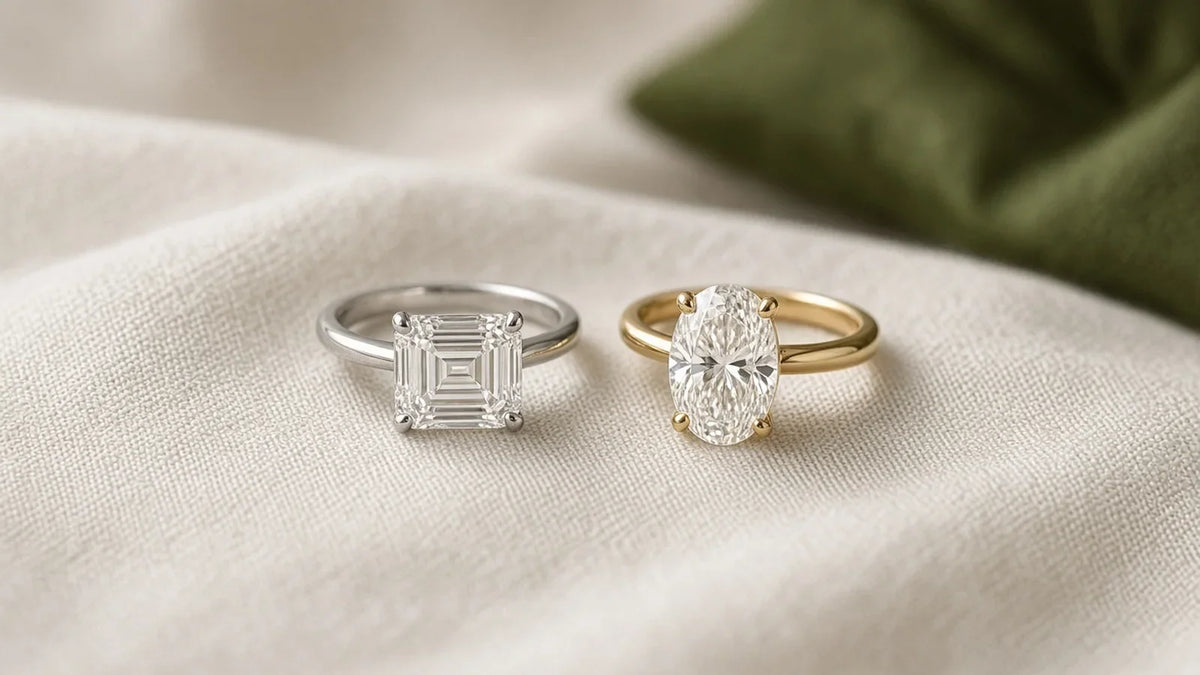
Choose emerald or oval by the outline and visual character you enjoy, then compare individual stones and the setting around them. Carat weight alone does not settle which shape suits your ring. An emerald-cut diamond offers cropped corners and straight lines; an oval offers a continuous, elongated curve.
Compare the outline before the number
IGI's shape guide describes emerald shapes as rectangular with cropped corners and large facets, and ovals as elongated. GIA's emerald-cut guide explains the concentric facet pattern and why colour and inclusions can be more apparent in this cut.
- Emerald direction
- Start here if you like straight edges, visible corners and a geometric composition. Ask whether you prefer a fuller rectangle or a longer outline.
- Oval direction
- Start here if you like rounded ends and a continuous curve. Ask whether you prefer a fuller oval or a more elongated one.
Neither is a rule about personality or occasion. A ring for yourself can have either character, and a quiet design can use either outline.
Read length and width together
Ask for actual length, width and depth in millimetres. Dividing length by width gives a length-to-width ratio: a larger ratio describes a more elongated outline. It does not grade the diamond's beauty or prove that its proportions are suitable for a particular setting.
Illustrative ratio example: an outline drawn 9 units long and 6 units wide has a ratio of 1.50; one drawn 9 by 7 has a ratio of about 1.29. Both have the same length, but the second is fuller. These are invented drawing dimensions, not measurements of available stones.
The carat and millimetres guide explains why weight and visible footprint answer different questions. Compare like with like: the same view, comparable scale, and the individual measurements alongside each image.
Use the report and visual evidence for different questions
For an emerald cut, discuss how visible features and colour look in the actual stone rather than choosing a clarity label automatically. For an oval, ask to see the centre as well as the ends while the stone moves. Describe any dark area or uneven appearance you want clarified; an attractive still image may not answer that question.
Request images or video identified as the proposed diamond, ideally in comparable conditions if you are choosing between candidates. Ask which information comes from the laboratory record and which is a supplier's observation. Our report-matching guide gives a practical check before approval.
Judge the complete ring in more than one view
A top view shows the outline; a side view helps explain height and the relationship to the band. Ask how the proposed stone's dimensions affect the setting direction and whether a neighbouring ring has been considered. Bring the dimensions or photographs of an existing band if wearing them together matters.
Visible metal also changes the composition. Use the bezel and prong comparison to describe whether you prefer a framed outline or more exposed edges. A concept image cannot confirm the fit or construction of a final ring.
Turn the preference into a short brief
Read our emerald cut engagement ring guide and oval engagement ring guide, compare emerald and oval stones in the diamond library, then explore settings. Write one preference and one open question: for example, a geometric outline with uncertainty about height, or a fuller oval with uncertainty about visible metal.
Prepare your design brief with those choices. The next decision is a considered proposal using a specific stone, not simply a larger carat number.
By STELLIVON. Source checked October 3, 2026. Laboratory references explain general principles; they do not certify STELLIVON or an individual ring.