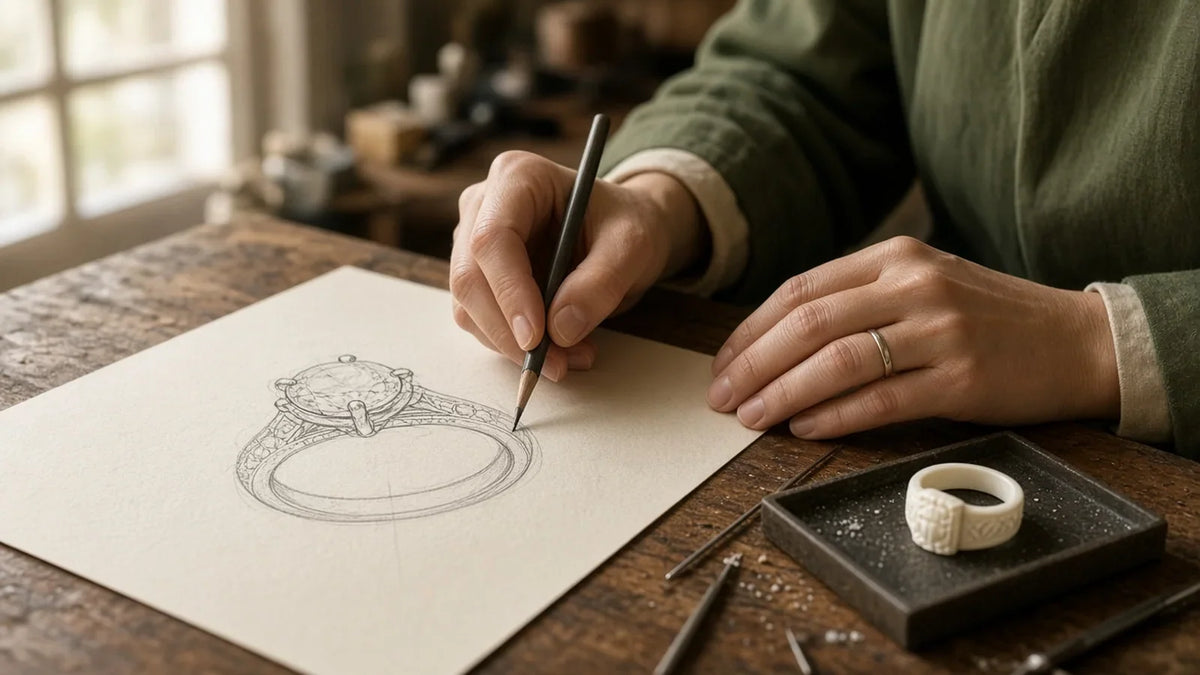
A ring can be personal without starting from a completely new structure. Personalising an existing direction begins with a design you already like; an original commission explores an idea that goes beyond that starting point. The useful distinction is how much needs to be resolved, not how meaningful the occasion is.
Name what you want to keep
Look at a design such as the solitaire or bezel ring, or compare directions in the setting gallery, and describe the feature that draws you in: the outline, balance of stone and band, or amount of visible metal. Those observations give the discussion a useful base.
Do not rely on a style name alone. GIA distinguishes the way a stone is held, such as prong or bezel, from an overall style such as solitaire. Its ring-setting guide explains the difference. “A solitaire with a softer band profile” is a more focused request than “something completely different.”
Separate preference changes from structural questions
- Begin with an existing direction
- You want to explore a different stone proportion, metal preference, size or personal detail while keeping the central design idea.
- Explore an original direction
- You want a different arrangement, relationship between components, or structure that needs new design review.
These are starting categories, not automatic approvals. A change that looks small in a picture can affect fit or construction; an ambitious visual idea may have a simpler interpretation. Ask which changes are feasible for the selected stone and what development, if any, belongs in the proposal.
Do not assume that selecting a concept reserves a stone, confirms every option or includes unlimited changes. The written scope should identify what is being explored and how any further changes will be addressed.
Turn your references into decisions
Choose a small number of references and annotate each one. Write what you like and what you do not want to reproduce. A reference may show colour, outline or a mood; it does not explain ring size, side profile or stone identity. A new design discussion is more useful when it aims at your priorities rather than copying another maker's finished piece.
- Essential: name one or two features you would be unhappy to lose.
- Flexible: identify details you are willing to change after review.
- Wear: say whether the ring stands alone or sits beside an existing band, and describe any practical concern.
- Open: flag unknown size, uncertain metal or a shape you still want to compare.
Illustrative brief: “I like the Oval Silhouette's curved outline. The essential feature is a quiet, single-stone look. I am flexible about visible metal and want to discuss wearing it beside my existing band. My size still needs confirmation.” This is an example, not a customer story or approved specification.
Make the scope concrete before approval
Ask which views or specifications will explain the design, which version will be approved, and which details remain open. If new design development is required, ask what its proposed scope and cost cover. A top view alone may leave height and neighbouring-ring clearance unresolved.
Before making, the individual proposal should connect the actual stone and report status with the setting, metal, size, complete price and timing. Use the quote checklist to review those details. Proposed making time and transit time need separate confirmation.
Start with the parts you already know
Explore engagement ring settings or prepare a design brief. Say explicitly if you are unsure which route fits. You can keep the meaning private and share only the design choices; a clear brief does not require a personal history.
By STELLIVON. Source checked October 3, 2026. Laboratory references explain general principles; they do not certify STELLIVON or an individual ring.